
Improve Pet Food Meat Slurry Quality and Compliance
Project Overview
Fluid Dynamics was engaged to design, manufcature and supply a cooling solution for a leading Australian poultry processor for its pet food by-product stream of chicken viscera – trimmings, mechanically deboned meat (MDM), ground necks, backs and feet.
Historically treated as low-value waste, this high-protein slurry presented an opportunity to improve product quality, extend shelf life and increase commercial value provided that temperature control and regulatory compliance could be reliably achieved.
Project Overview
Fluid Dynamics was engaged to design, manufcature and supply a cooling solution for a leading Australian poultry processor for its pet food by-product stream of chicken viscera – trimmings, mechanically deboned meat (MDM), ground necks, backs and feet.
Historically treated as low-value waste, this high-protein slurry presented an opportunity to improve product quality, extend shelf life and increase commercial value provided that temperature control and regulatory compliance could be reliably achieved.
The Engineering Challenge
The objective was clear:
- Reduce product temperature from ~23 °C to below 4 °C
- Maintain continuous processing
- Prevent product freezing
- Ensure compliance with Australian food safety requirements
- Handle highly viscous, non-Newtonian material
Technical Constraints
The slurry exhibited:
- High viscosity and variable solids content
- Risk of slug flow (core channelling)
- Low wall velocity under laminar conditions
- Freezing risk at the heat transfer surface
With glycol coolant operating below –5 °C, conventional tubular heat exchangers would likely result in:
- Product freezing at the tube wall
- Insufficient cooling at the core
- Fouling and production downtime
A different heat transfer mechanism was required.
Design Rationale
Fluid Dynamics specified an HRS R3 Series Scraped Surface Heat Exchanger (SSHE) to:
- Mechanically remove product from the heat transfer surface
- Eliminate boundary layer build-up
- Prevent wall freezing
- Ensure full radial mixing
- Maintain consistent outlet temperature
Why Scraped Surface Technology?
In highly viscous applications, heat transfer is limited by poor convection and low wall shear. The rotating scraper blades:
- Continuously renew the product film at the surface
- Disrupt laminar flow patterns
- Eliminate central channelling
- Increase overall heat transfer coefficient
This approach transforms a problematic cooling duty into a controlled, predictable process.
The Solution
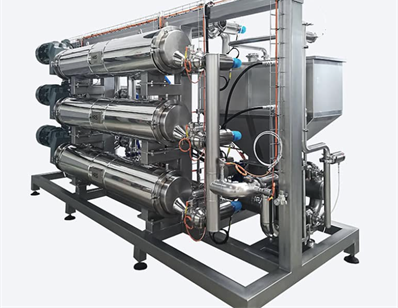
The final system comprised:
- Three off HRS R3 Series SSHE units in parallel
- Stainless steel skid-mounted frame
- Receiving hopper with auger feed
- An HRS BP8 piston pump for efficient viscous product transfer
- Dedicated glycol circulation pump
- Standalone control panel
Parallel Configuration Strategy
Running three exchangers in parallel delivered:
- Redundancy (2 duty + 1 standby)
- Maximum throughput when all 3 units operated simultaneously
- Online cleaning flexibility
- Capacity scalability during peak production
- Improved operational reliability
Mechanical Adaptations for High Torque
Given the product’s viscosity and solids content:
- Internal scraper geometry was modified
- Heavy-duty gearboxes were installed
- Torque capacity was increased
ensuring reliable rotation under load and maintaining consistent wall scraping performance.
| Parameter | Value |
| Throughput | Up to 3.5 tonnes/hour |
| Inlet Temperature | 23 °C |
| Outlet Temperature | 3.5 °C |
| Residence Time | ~4 minutes |
| Cooling Medium | Glycol (< –5 °C) |
| Construction | Stainless steel, skid-mounted |
The system:
- Achieved rapid cooling without freezing
- Delivered stable outlet temperatures
- Reduced microbial risk
- Improved product consistency
- Exceeded client performance expectations
The client has subsequently ordered a second, larger scraped surface system for another of its facilities.
Engineering Outcome
This project demonstrates that:
- Scraped surface heat exchangers are highly effective for viscous protein slurries
- Wall freezing can be eliminated even with sub-zero glycol
- Parallel SSHE design improves uptime and maintainability
- Thermal control directly increases product value and regulatory compliance
Fluid Dynamics, the Heat Exchange Specialists, for all your heat exchanger needs
Advice • Design • Manufacture • Refurbishment • Repair • Service